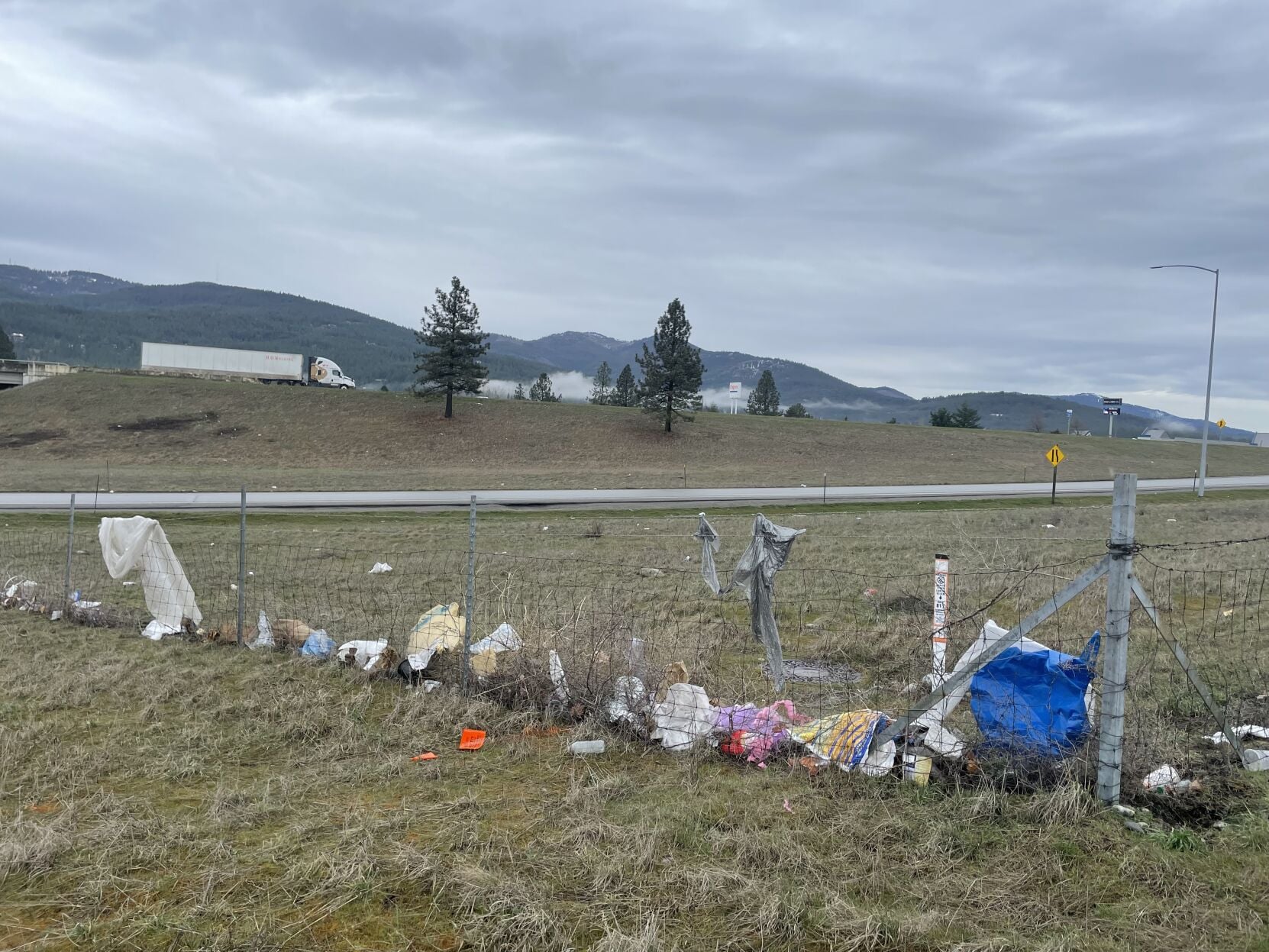
POST FALLS, Idaho — If you’ve driven I-90 through Post Falls lately, you’ve probably noticed trash tangled up in the protective fencing along the highway.
And the entrance to downtown Spokane isn’t any better, plastic draped tree branches are visible before the Division Street exit.
This year’s unusually mild winter has pulled back the curtain on just how much trash piles up along our highways. What’s normally buried under snow and ice is now on full display.
“It’s definitely the time of year where we start seeing an increase in the complaints, people wanting to know who’s going to come out and clean this up? When’s it going to get taken care of?” said Heather McDaniel, who handles public information for the Idaho Transportation Department.
I-90 and Highway 95 see the heaviest traffic in North Idaho, and that’s where you’ll find the biggest messes. It’s basically a numbers game; more cars mean more trash.
According to Washington’s Department of Ecology, they usually find cigarette butts, food wrappers, snack bags, glass bottles and construction debris. But 40% of highway trash isn’t even from people deliberately littering. It’s stuff falling out of unsecured truck loads.
Washington State Patrol troopers keep an eye out for those violations. Get caught with an unsecured load and you could face fines anywhere from $50 to $5,000. If something falls out and hurts someone? You might be looking at jail time.
Washington spent millions last year just on litter pickup. WSDOT spent $10.3 million statewide in 2025.
“The Department of Ecology and the Department of Transportation spent just over 17 million dollars in 2025 for litter pickup efforts,” said Ryan Plouse, who coordinates litter cleanup for the region with Washington’s Department of Ecology.
There are four dedicated litter crews with the Department of Ecology covering eastern Washington. Two based in Spokane, two in Moses Lake. These aren’t volunteers, they are full-time seasonal workers putting in 40-hour weeks from March through November, assuming the weather cooperates.
But even with all that money and manpower, they can’t keep up. The sections of highway with the most traffic aren’t always going to get repeated litter removal.
“It’s difficult to have those be continually cleaned, so we do the best that we can with the resources that we have available, and part of that is our litter prevention side of things as well, right? If we can try to prevent the litter from occurring then we don’t have that issue to begin with,” Plouse said.
Idaho handles things differently. There’s no dedicated ecology department with paid litter crews like Washington has. Instead, Idaho Transportation Department workers pick up trash when they’re not busy with their main jobs: fixing guardrails, replacing lights and signs, and handling safety issues.
“It is a much better use of tax payer resources for them to be out doing the jobs that they are needing to do rather than pick up trash, which again goes back to why we ask people, keep trash in your cars, cover your loads, do all of those things so that it doesn’t become a job that somebody has to take on,” McDaniel said.
Volunteers step in too. Idaho’s Adopt a Highway program saves the state about $750,000 every year in cleanup costs. Julie Youngman coordinates these volunteer efforts in North Idaho, and she says people notice when things get really bad.
“And they’re like, ‘This is an embarrassment. My family’s coming. This is a beautiful part of Idaho. We don’t want it to look like this,’ and neither do we,” Youngman said.
Washington has Adopt-a-Highway volunteers too, you can sign up online and receive safety vests, hard hats, traffic signs and litter bags. Each volunteer group takes on a two-mile stretch and commits to cleaning it at least twice a year. Last year alone, volunteers across five northern Idaho counties hauled away more than 88,000 pounds of trash.
Youngman says she’s already hearing from volunteers earlier than usual this year, with cleanup schedules filling up fast.
“I wouldn’t say it looks worse, I just think it’s prior to everyone getting out there,” she said.
COPYRIGHT 2026 BY KXLY. ALL RIGHTS RESERVED. THIS MATERIAL MAY NOT BE PUBLISHED, BROADCAST, REWRITTEN OR REDISTRIBUTED.