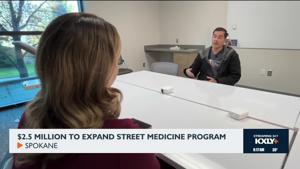
SPOKANE, Wash. – Funding keeps street medicine running in Spokane, bringing care to people experiencing homelessness where they live.
For people living on the streets, traditional healthcare may not be an option. Barriers such as money and transportation can stand in the way. Street medicine fills that gap by bringing essential services directly to them.
The COVID-19 pandemic forced the start of this approach six years ago. In 2020, Washington State University partnered with CHAS to make sure vulnerable populations did not fall through the cracks while people were isolating at home.
Luis Menriquez, director of community health equity at the WSU College of Medicine, has worked in street medicine in Spokane since the beginning.
“There was nothing like it, and now, I would say, it would be hard to imagine healthcare for people on the street without us,” said Menriquez.
The work ranges from routine to urgent. Providers may treat a dog bite wound on site. They may also recognize a more serious emergency.
“It may be coming across someone who has had a dog bite and has a wound that needs to be addressed, so trying to clean that up and address it on the site. It can be someone who has chest pain and needs to go to the emergency department, and we have to facilitate them getting to the emergency department,” said Menriquez.
Menriquez says the relationships built in the field shape the care patients receive.
“And if you go and see them they are at they are thankful, appreciative, they are willing to show you the stuff that matters to them, and you get a sense of what they are up against, and so that just allows you to provide better care”
The Health Resources and Services Administration recently awarded WSU $2.5 million to expand its street medicine rotations in Spokane and Everett. Each year, between six and 12 medical student residents will gain hands-on experience working with people experiencing homelessness. In Spokane, the program runs in partnership with CHAS and the Cascadia Street Medicine Alliance.
Delaney Goulet, assistant program director for WSU’s Internal Medicine Program, helped secure the funding. She says the grant gives residents access to the community.
“By receiving this grant money, we are able to build clinical experiences for our residents that allow them to get into the community and work with expert preceptors in the space and learn skills with fewer resources than they might have in the hospital,” said Goulet.
Goulet says the program aims to train well-rounded healthcare professionals who may later work in rural or underserved communities.
Homelessness is growing across Washington State. Goulet expects the training to increase the number of providers who support this population.
“Homelessness is a growing problem across the state with increasing numbers, and so I think that in training physicians who plan to practice in Washington State, this will just reinforce that we will have more providers supporting this population”
The $2.5 million will fund the expansion for the next five years. Goulet and Menriquez both hope this marks the beginning of a larger program.
Menriquez points to recent local progress.
“We are improving lives for people on the streets. All the time, the things that are being done in the city are having an improvement. The number of people on the street are going down; the number of overdoses are going down.”
COPYRIGHT 2026 BY KXLY. ALL RIGHTS RESERVED. THIS MATERIAL MAY NOT BE PUBLISHED, BROADCAST, REWRITTEN OR REDISTRIBUTED.