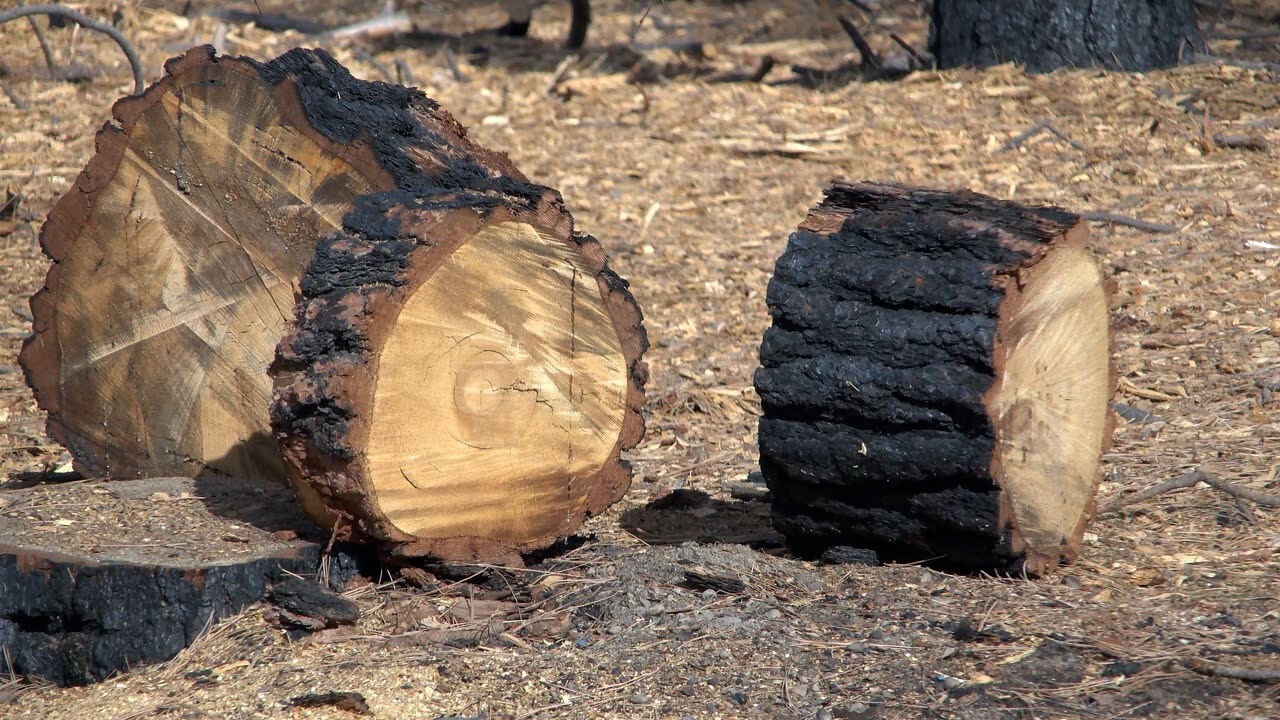
SPOKANE, Wash. — The Washington State Parks and Recreation Commission has approved a plan to address thousands of hazard trees burned during the Old Trails Fire at Riverside State Park by conducting a salvage harvest of the dead timber.
The Old Trails Fire burned 1,500 acres of Riverside State Park, leaving behind charred trees that pose significant safety risks to visitors and park infrastructure. Today’s decision allows the state to cut down and sell timber from 400 acres of the burned forest. The park estimates it can harvest approximately 1.6 million board feet of timber from the dead trees.
While the salvage harvest represents a significant undertaking, the financial reality reflects the scale of the wildfire’s impact. The timber sale will result in a net loss of $260,000 for the state parks system. However, this approach is substantially more cost-effective than the alternative: simply removing the dead trees without selling the timber would cost approximately $20 million.
“Removing the hundreds of hazard trees that remain in this area near homes, roads and public infrastructure is still a very high priority need for us. Salvage logging in this case allows us to do that scale of hazard tree removal much more cost-effectively,” said David Cass, a forester with the State Parks and Recreation Commission.
Since the Spokane area fires, park rangers have worked continuously to clean up and reopen sections of Riverside State Park. A primary concern has been identifying and removing hazard trees that pose safety risks to visitors and park infrastructure. The thousands of charred trees remaining throughout the park created both a safety challenge and a resource management question.
The salvage harvest represents a creative solution to the recovery process. Rather than treating the dead timber as waste, the state will extract and sell the wood, generating revenue that offsets some of the removal costs. This approach allows the park to address the immediate safety concerns while contributing to the broader wildfire recovery efforts in the region.
Foresters acknowledge that the restoration process will extend well beyond the initial three-month cleanup timeline. The natural recovery of the park will require years of careful management and monitoring.
“With proper management and time, those materials will decompose. In 10 years, with proper care, I expect this area to look much more natural with abundant snags, dense young forests and a diverse and thick native understory,” Cass said.
COPYRIGHT 2026 BY KXLY. ALL RIGHTS RESERVED. THIS MATERIAL MAY NOT BE PUBLISHED, BROADCAST, REWRITTEN OR REDISTRIBUTED.